|
Ga naar de:
WEBWINKEL:
WEBSITE:
HOME (Start)
ALGEMEEN:
Downloads
FAQ's _ Vragen
Weer & Nieuws
BESTELWIJZE
Gratis Adverteren
Wapenboeken
Even lachen?
| |
|
|
|
|
Electronic Collar
Buyers’ Guide
by Geoffrey
A. English
In an era of high speed Internet
access, cell phones, and palm pilot organizers, it was only
a matter of time before gundog enthusiasts would adopt the
electronic training collar as an acceptable and humane way
of training dogs. Notice I did not use the term “shock
collar”. The reason will become clear after a brief look
into the evolution of “The Electronic Collar”.
More than 30 years ago,
electronic collars made their way into the dog-training
scene. However, because the first generation of electronic
collars were only capable of delivering one level of
stimulation to the dog, they where appropriately nicknamed
“shock collars”. These collars required the trainer to
select the level of correction by inserting an “intensity
plug” into the collar (before putting the collar on the
dog for training, once the collar was on the dog they could
not change the intensity level). This plug would then cause
the collar to emit the same level of stimulation for all
corrections issued during the session, regardless of how
small or large the infraction – hence the nickname
“shock collar”.
The term “shock collar” had a
very negative connotation that dramatically decreased their
widespread acceptance in the dog-training arena. It was
commonly stated that, “Only hard headed dogs that could
not be trained by traditional means where run with shock
collars”. As a result, very few professional trainers were
public about their use of electronic collars fearing that
clients would not entrust dogs to their care. However, some
professionals, including legendary Rex Carr, where up-front
about their use of electronic collars and worked diligently
at developing a training program that utilized the collar in
a way dogs could understand. Rex quickly became know as a
pioneer of training retrievers with electronic collars. In
fact, most if not all training techniques used today with
retrievers are derivate from Rex’s original work.
Recognizing the limitations of
the first generation of electronic collars, manufacturers
worked to refine their design. It was only until the release
of the second generation of electronic collars that allowed
the trainer to vary the level of intensity from the
hand-held transmitter. The trainer could now select from one
of three levels of intensity for a particular “intensity
plug”: high, medium and low. This design still had its
shortcomings. The trainer still only had 3 levels of
stimulation to choose from and the lowest level of
stimulation was typically inappropriate for simple
corrections.
While the second generation of
electronic collars was a great advancement in training
collars, this technology was replaced in the last decade by
collars that gave the trainer the ability to select multiple
levels of intensity from the transmitter. This single
advancement combined with customer education has done more
for the widespread acceptance of the electronic collar than
any other advancement in the collar’s history.
Manufacturers quickly recognized
that a great design alone was not going to give their
product the acceptance needed to support their newfound
industry; it was only through education that new customers
would understand how to use these training devices to
advance their dog in a proper manner. The most significant
form of education came when Tri-Tronics released a book
written by Jim and Phyllis Dobbs and Alice Woodward, Tri-Tronics
Training Retrievers. This book focused on incorporating
electronic collars in all phases of training retrievers and
walked the reader through a series of detailed steps,
bringing a dog from A to Z.
As a result of the technological
advancements and the educational support provided by
manufacturers, the days of the “shock collar” are gone,
giving way to the remote training collars. Today, like cell
phones, its becoming more difficult to find someone who
trains without an electronic collar.
|

|
|
|
r.
|
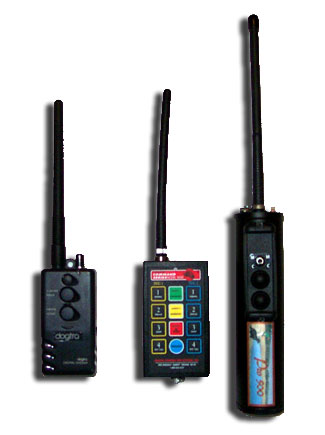
The remainder of this article will focus on
the technology found in many of the collars manufactured by
the industry leaders and explain how each is applicable in
training gundogs and your selection of an electronic collar.
Types of Stimulation -
Continuous Stimulation vs. Momentary Stimulation
Let’s start by defining the two
forms of stimulation available on the market today. First,
there is continuous stimulation; this method of stimulation
delivers an electronic correction to the dog for as long as
the trainer presses the button on the transmitter. If the
trainer holds the button down for five seconds the dog will
receive five seconds worth of stimulation. However, most
models on the market today will timeout after seven to ten
seconds of stimulation has been applied to the dog.
The second form of stimulation
available on some collars is momentary stimulation.
Momentary stimulation, sometimes call a “nick”, is
different from continuous stimulation in one simple way; no
matter how long the trainer depresses the button, the dog
will only receive a short electronic correction, the
duration of which is measured in a fraction of a second.
When might you use continuous
or momentary stimulation?
Continuous form of stimulation
can be used in training when you need to extend a meaningful
correction to your dog and re-establish control of a
training situation. A great example of a training scenario
where you might need to apply continuous stimulation is when
you need to gain control over your dog on a runner. In this
situation, a simple “nick” or short burst of stimulation
may do nothing to stop him on that illusive cock pheasant.
Often, a dog might just run through a short burst of
electronic stimulation because he is too excited about the
prospect of fresh scent to listen to your sit or “hup”
whistle. The continuous level of stimulation is what is
required to stop him in his tracks. Because the correction
is applied to the dog for as long as you hold the button
down the effect to the dog is a stronger form of correction.
Another example of when continuous stimulation would be a
valuable training tool would be when teaching a flushing dog
to turn on the “come around” whistle. Here you would use
a much lower level of stimulation and apply the stimulation
in conjunction with the “come around” command/whistle,
only releasing the pressure when he complies with your
command. In both training scenarios, the dog has to be
taught the way out of the pressure (or the correct response)
before utilizing a collar.
|
|
|
|
|
|
|
|
Momentary stimulation can be used in training
when you need to apply a short, light form of correction. A
classic training scenario where we would use momentary
stimulation is when utilizing “indirect pressure” during
training. With indirect pressure, you want to apply a short,
quick correction for not compiling to a command after you
have gotten control over him through attrition. For example,
if your dog refuses to take a “right-handed angled back”
command on a blind retrieve, momentary stimulation can be
used after stopping him with a firm “sit” whistle,
“nicking” him once he is sitting for refusing to take
the “right-handed angle back” command, then re-issuing
the “angle back” command. In this case, the momentary
stimulation applies a short less intense correction that
does not “rock the boat”.
Range
Upon first consideration, you may
not think that you would need an electronic collar that has
a range of one mile. However, if you are hunting over a big
running pointer, in the thick backwoods of New England, you
might be better served with a collar that has an effective
range of a half-mile or greater than a collar with less
range. Most manufacturers quote “line-of-sight” range
for their collars. However, the effective range of an
electronic collar can vary according to terrain and
environmental conditions. For basic obedience and most yard
work, a collar that is capable of extending to 150 to 300
yards is more than adequate. However, if you are training in
the field or working in any type of cover, more range is
needed to produce a reliable signal.
Intensity Levels
Maybe the most important
advancements in the electronic collar in the past ten years
has been the change in the design of the electronic collar
to allow a trainer to change levels of stimulation at the
transmitter, rather than at the collar. In days gone past, a
trainer could only change the levels of stimulation by
physically changing the “intensity plug” and/or contact
points on the collar itself.
Today, virtually all quality
electronic collars on the market allow the trainer to select
the level of stimulation from the transmitter. The old term,
“shock collar” is no longer accurate, the term
“electronic training collars” has since replaced this
term primarily due to this single design change which allows
a trainer to select just the right amount of stimulation
necessary to correct the dog making the electronic collar a
humane approach to training dogs. Now you can select a mild
level of stimulation (barely noticeable by human touch) or a
severe level of correction that would make even the toughest
man take notice. The responsibility is now with the trainer
to select the appropriate correction for the dog.
Transmitter Design
Probably the most important
factor in regards to usability of an electronic collar rests
within the transmitter design. Most transmitters on the
market today fit easily into your hand. However, differences
exist in the design of the transmitter. Some manufacturers
make transmitters that are small, lightweight and can be
hung on a lanyard. Other manufacturers make transmitters
that are larger but extremely easy to use. Like most things
in life, it comes down to personal preference. In order for
any collar to be an effective training device it must be
easy to use and be able to apply the correction at the exact
moment it is needed. The last thing you want to be doing is
fumbling for your transmitter, setting an intensity level
when you should be delivering a firm correction that the dog
will understand.
The last feature to take into
consideration when evaluating the design of a transmitter is
the resistance of the transmitter to weather. Some
transmitters are water resistant while others are
waterproof. If using an electronic collar while waterfowling
you might want to consider a transmitter that is waterproof
and can endure a “fall in the drink”.
Collar Design
The final consideration when
choosing an electronic collar is the design of the collar/receiver
unit itself. Some earlier models of electronic collars,
intended for upland use, had external antennas that extended
beyond the body of the collar and often became caught up on
or became damaged by heavy brush. This design has since been
replaced with antennas that are self-contained within the
body of the receiver unit.
Like the transmitter design,
collars also come in units that are water resistant and
waterproof. If you intend on using your dog in or around
water I would highly recommend purchasing a collar that is
waterproof. These collars can be fully submerged in water
while in the field without harming the internal electronics,
a must for most hunters.
Final Note
Used correctly, the electronic
collar can be an invaluable tool when training your gundog.
There is no other tool that can help you effectively apply a
correction to your dog than one of the many electronic
collars on the market today. The days of chasing down your
dog to apply a traditional correction (only have lost the
significance of the) are long gone. Now you can effectively
and reliably apply the correction at the moment when it is
needed. Do your homework, if you have any questions
regarding the selection an electronic collar, please don’t
hesitate to call GundogsOnline.com toll free at
1-866-4GUNDOG.
|
|
|
|
|